
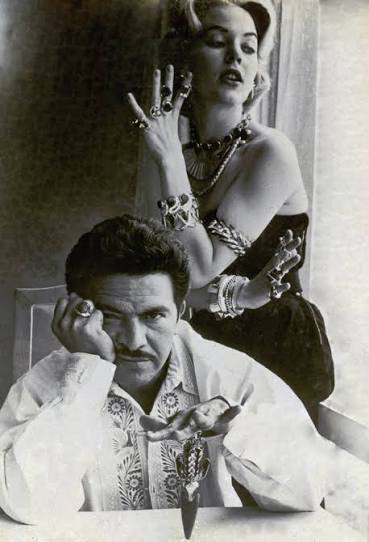
Antonio Pineda Gómez (1919–2009) was among the most accomplished and technically inventive silversmiths of the Taxco renaissance. Born in Taxco into a family of ten children, he entered the world of silver as a boy, according to the story that follows his early career, William Spratling noticed him playing in the fountain at the Taller de las Delicias and took him on as an apprentice.
Spratling’s workshop was built on the idea that modern Mexican decorative art should draw on the country’s own heritage rather than reproduce European styles, and Pineda absorbed that vocabulary. But his apprenticeship was brief, and the painter and silversmith Valentín Vidaurreta encouraged him to find a language of his own. By the 1950s the pre-Columbian references had given way to abstraction, geometry and sculptural volume: large polished surfaces of silver, interrupted by carefully placed stones, openings and articulated elements.
The modernity was never only visual. Pineda built apparently massive pieces hollow, controlling their weight while keeping the physical presence he believed silver jewellery should have, and engineered hinges and catches so that a necklace which looks rigid on a table articulates around the body. His treatment of stones was equally structural, amethyst, onyx and pearl set almost suspended within the silver, the two materials interdependent rather than one merely framing the other.
A 1944 exhibition at the California Palace of the Legion of Honor brought him to the attention of Richard Gump, who bought his collection and became an important distributor in the United States. His work was later shown in Mexico, the United States and Europe. He remained a Taxco silversmith throughout, but his jewellery of the 1950s belongs to the wider history of international modernist jewellery, negative space, modular construction, asymmetry and articulated sculptural form, arrived at from within the Mexican tradition rather than borrowed from Europe.